
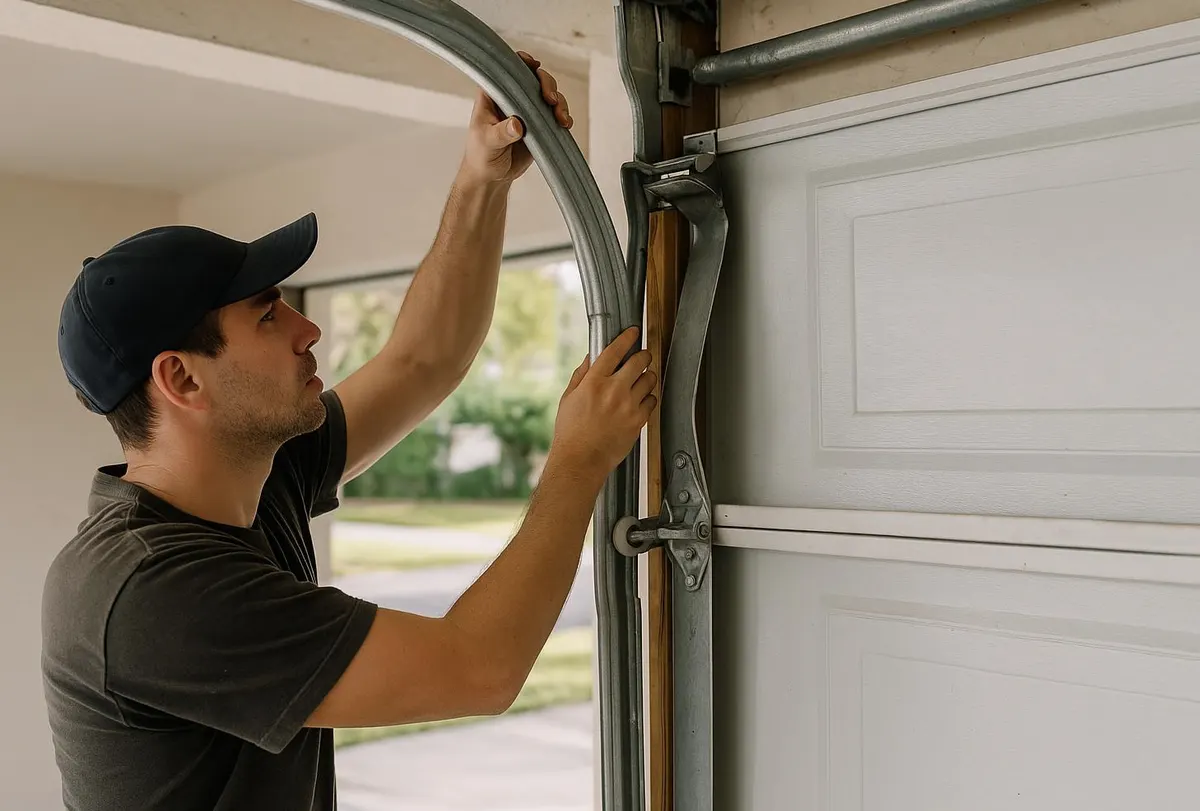
What a Technician Sees on a Typical Call
Most service calls start the same way: one spouse says the door is "basically new" and the other says it's "on its last leg." When a technician actually opens the garage, the truth is usually in the middle. The springs are rusted at the coils even though the door still opens fine. The opener's logic board is five years old but the chain is stretched and noisy. The bottom weatherstrip is cracked and letting in water during afternoon downpours. None of that means the system is dying tomorrow — but it does mean the clock is ticking faster than the label on the door would suggest.
The Honest Lifespan Numbers
These are general ranges, not promises — actual lifespan depends heavily on usage and conditions:
- Garage door (steel, standard residential): roughly 15–30 years with reasonable care.
- Torsion and extension springs: rated for about 10,000–15,000 cycles, which usually works out to 7–12 years for an average household.
- Garage door opener (motor unit): typically 10–15 years before the motor, gears, or circuit board start failing.
- Rollers, cables, and hinges: often need attention or replacement every 5–10 years, well before the door or opener itself.
Notice that almost nothing on a garage door system is a "set it and forget it for 20 years" part. It's a system of components aging at different rates, and the weakest one decides how the whole door feels to use.
What Shortens That Lifespan Around Here
Southwest Florida isn't gentle on garage doors. A few local realities do real damage over time:
- Salt air near the coast accelerates rust on springs, hinges, and the track system, especially if the door isn't rinsed or inspected regularly.
- Humidity and moisture cause wood-composite panels and some steel doors to swell slightly, which throws off alignment and makes the opener work harder than it should.
- Heat inside the garage shortens the life of opener motors and electronics, particularly in garages that face west or get little airflow.
- Hurricane-season wind loads put repeated stress on tracks, panels, and anchor points even when a storm doesn't cause obvious damage — the cumulative flexing adds up.
- Skipped maintenance is the biggest multiplier. A door that's never lubricated or rebalanced will wear out its springs and rollers years earlier than one that's checked annually.
Signs the Clock Is Running Out Faster Than Expected
- Visible rust on spring coils or hinges, even if the door still moves
- The door feels heavier to lift by hand than it used to
- Opener makes grinding or straining noises partway through a cycle
- Door doesn't sit flush at the bottom, or light shows underneath
- Opener's remote range has noticeably shrunk
What Actually Extends It
None of this is complicated, but it has to happen consistently, not just once:
- Lubricate moving parts (rollers, hinges, springs) every few months with a silicone-based lubricant, not WD-40, which attracts grit.
- Have springs and cables inspected annually — they're the most cycle-limited part and the most dangerous to ignore.
- Check the door's balance by disconnecting the opener and lifting it halfway by hand; it should stay put. If it drops or shoots up, the springs are compensating incorrectly and wearing out faster.
- Keep the opener's logic board protected from direct heat and moisture; a surge protector helps during storm season when power fluctuates.
- Replace weatherstripping before it cracks, since water intrusion speeds up rust on everything behind it.
- Before hurricane season, make sure the door meets wind-load expectations for the install and that panels, tracks, and anchors are solid — stress on a compromised door during a storm is how small problems become total failures.
So Who's Right?
If the door and opener have had zero maintenance in 10+ years, the spouse predicting an imminent failure is probably closer to correct — not because the parts are automatically worn out, but because nobody's been checking. If there's been regular lubrication and at least one professional inspection, a door in the 15–20 year range can still have real life left, especially if the opener was replaced more recently.
When to Call Fort Myers Garage Door Service
If springs look rusted, the door feels unbalanced, or the opener is straining, it's worth having it looked at before it fails during a storm or at an inconvenient moment. Fort Myers Garage Door Service handles Spring Repair & Replacement and Preventive Maintenance visits that catch these issues early — checking balance, lubricating hardware, and inspecting for the rust and swelling that's common in this climate. A quick inspection now is a lot cheaper than an emergency call later.
Settle the argument for good — call Fort Myers Garage Door Service for an inspection anywhere in Fort Myers, FL and the surrounding area.